| 
Summary:
RO is the preferred technology for many
commercial/light industrial applications where feed water purification
and final product water consistency are essential. Growth of U.S.
microbreweries has created an opportunity for this application.
The following case study offers an additional area of interest
in that the feed water to the microbrewery is product from a local
municipal RO plant.
|
"As
Seen in Water
Conditioning & Purification"
POE
Applications for a Microbrewery
A case
study
Beer, by definition,
is an aqueous solution, 91-to-97 percent of which is water. The importance
of water quality in beer production cannot be understated and was the
driving force behind consideration of a particular reverse osmosis (RO)
water purification system for brewing.
The Outer Banks
Brewing Station, in Kill Devil Hills, N.C., is a microbrewery with a
projected need of up to 3,000 gallons per day (gpd) of purified water
to support production of 500 gallons per batch of its brewed products.
A microbrewery is a brewery that produces less than 15,000 barrels (17,600
hectoliters) of beer per year. Raw water supplied to the microbrewery
from the local municipal RO plant lacks the quality and consistency
needed for optimal brewing.
Importance
of water source
Long before the
water chemistry behind the brewing process was scientifically understood,
great breweries sprang up in the proximity of excellent water sources.
If the local water source was inadequate for proper brewing, the beer
produced would be of poor quality. Either the brewery moved to a better
source of water, adapted their brewing techniques, or they perished.
Water profiles
from the classic brewing regions are surprisingly different from each
other, accounting for the evolution of unique beer styles from those
areas (see www.barandbeer.com or www.ebraumeister.com for beer types).
It was the early trial and error compensating methods in addition to
the presence of certain mineral ions that determined the style of beer
that evolved from an area. When certain Munich brewers moved to Prague,
they were amazed at how light and delicate their beers turned out from
essentially the same recipes and ingredients used in Munich.
What’s most
important to the brewer is the effect the brewing water has on mash
pH. Malt enzymes are very particular about temperature and pH, and mashing
is essentially an enzymatic process. Proper mash pH, usually preferred
at around 5.2-5.4, can be achieved by several means. In the early days
of brewing, methods were mostly limited to malt composition and biological
acidification. Modern breweries may add food grade acids such as lactic
acid or phosphoric acid to adjust the mash pH.
London water is
high in carbonate ions, which tends to drive the mash pH up, but dark
roasted malts acidify the mash and the balanced pH results in excellent
porters. North of London in an area called Burton Upon Trent the water
has extremely high levels of dissolved minerals, especially gypsum,
which lowers mash pH, thus enabling a balanced mash with minimal dark
malts resulting in exceptional pale ales.
It’s interesting
to note here that both Prague and Burton Upon Trent produce world class
light beers while Prague has very low total dissolved solids (TDS)—around
31 parts per million (ppm)—and Burton has exceptionally high TDS
(around 1,226 ppm). The reason they both work for brewing is the overall
balance of ions and especially the residual alkalinity (RA):
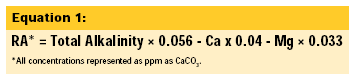
RA
values less than 1 are considered good brewing water. By this formula,
Burton Upon Trent water is actually superior to Pilsner (Prague) water.
In fact, the practice of adding gypsum to brewing water to achieve a
lower mash pH is still sometimes referred to as “Burtonization.”
There are many
subtleties to managing the ion balance. While it’s essential to
keep the mash in the right pH range by whatever means, the presence
of certain minerals does have an effect on flavor and character of the
beer. Many minerals have a positive effect on brewing up to a point,
after which they’re detrimental, causing excessive saltiness,
sourness or bitterness. Yeast requires a proper balance of calcium (Ca)
with magnesium (Mg) for optimal fermentation along with several other
nutritional requirements. Thus, absolutely pure water would not make
very good brewing water. But by using RO as pretreatment for brewing
water, the brewer can add back minerals to suit any style of beer he
or she is trying to create or duplicate.
Along the outer banks
The Outer Banks
Brewing Station opened in May 2001. The beers produced by the microbrewery
were to be sold initially through its 215-seat restaurant, with limited
distribution of its products in kegs and bottles in 2002. Brewmaster
Scott Meyer planned to use RO water, possibly custom salted, in the
kitchen in addition to the beer production. He said, “I expect
that if we pay as much attention to the water that is used in our sauces,
stocks, and breads as we do to the water used for brewing, we can improve
on our foods.”
To produce the
highest quality product for his patrons, Meyer determined that a point-of-entry
(POE) water purification system would be essential to meet the following
objectives:
• Reduce the TDS and chloride concentrations from the raw water
to acceptable levels. Chloride concentrations must be below 25 milligrams
per liter (mg/L) for optimal brewing.
• Reduce the pH to enable precise pH control of the treated water
prior to brewing.
• Provide low TDS permeate as make-up water for cleaning solutions.
Acid and alkali cleaners are made much more effective if they’re
made up with low TDS water. “Beerstone” and other mineral
deposits can be very difficult to remove.
Source
water control
Raw water to the
Outer Banks Brewing Station is supplied by the Kill Devil Hills municipal
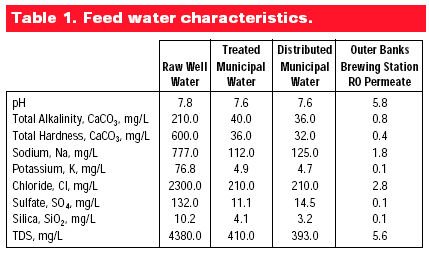
water plant. As shown in Table 1, the Kill Devil Hills plant utilizes
RO to reduce the TDS from local surface water supplies from 4,380 mg/L
TDS to a final blended product of about 400 mg/L TDS. Water from the
municipal plant has been treated after the RO process with chlorine
and caustic chemicals for residual disinfection and corrosion protection,
respectively.

Meyer decided to
use RO in his water treatment system as well to give him control of
the brewing water parameters. The purified water would give him a “blank
canvas” on which he could add back mineral salts in measured quantities
tailored to the different beer styles he produces. Additionally, RO
removes about 97 percent of sodium nitrate from the water. Nitrates
reduce to nitrites in solution, which are toxic to yeast.
As brewmaster,
Meyer turned to local dealer Le Bleu Water Treatment for a complete
water purification solution. A process designed to accommodate all the
purified water needs of the brewery was formulated by Le Bleu and the
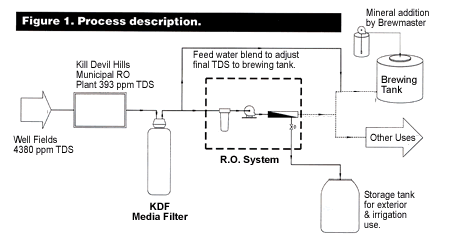
Outer Banks Brewing Station. As illustrated in Figure 1, the raw water
is pre-treated with KDF media for chlorine and organics removal prior
to treatment by the RO unit, which is sized to produce 3,200 gpd of
product water. Permeate or product water is output to brewing process
tanks for adjustment with brewing salts. The concentratestored
in separate tanks for outside use, such as irrigation. Concentrate recycling
was deliberately excluded from the RO equipment as it was determined
better control of the brewing process parameters could be maintained
while increasing overall system recovery by blending pretreated water
with permeate.

The RO system includes dual
high-flow (low-pressure) 4-inch × 40-inch membranes to maintain
the required production in the event the feed water temperature drops
below the optimal 77°F. Stainless steel pressure vessels, control
panel and high-pressure pump were installed on the RO skid for corrosion
resistance and to provide an appearance consistent with the restaurant
and brewing equipment of the facility.
Conclusion
Brewing beer is a complicated
process, combining craft and science. Brewmaster Scott Meyer and his
local water treatment dealer have conceived a water treatment system
tailored to the needs of a modern microbrewery. Reverse osmosis is a
critical element of this system since it provides the brewmaster with
the highest quality raw material upon which he can perform his craft.
Acknowledgments
The author would like to
thank Joel Walker, a water specialist with Le Bleu Water Treatment,
and Scott Meyer, one of the owners of the Outer Banks Brewing Station,
for their assistance on this article. Walker’s company is a division
of Le Bleu of The Outer Banks, a water treatment equipment and bottled
water supplier in Harbinger, N.C. He had over 16 years experience as
an independent water treatment contractor prior to joining Le Bleu last
year. Meyer is a certified brewmaster through the Siebel Institute of
Brewing Technology in Chicago.
References
- Institute for Brewing
Studies, Craft-Brewing Industry Fact Sheet, Chicago.
- The website: http://www.beertown.org
- The website http://www.brewingtechniques.com/library/backissues/issue6.1/williams.html
- Water analysis courtesy
of Health Department, Dare County, N.C.; sample taken March 3, 2001.
About
the author
Edward Closuit is president
of Haliant Technologies, a reverse osmosis equipment manufacturer based
in Sarasota, Florida. Closuit received a bachelor of science degree
in engineering from the University of Florida in Gainesville and a master’s
degree in business from Rollins College in Winter Park, Florida. He
has many years of experience in manufacturing water treatment equipment
and was previously president of Environmental Products USA Inc.